Tuesday, November 6, 2018

Aging in place -- big talk, but do people really believe it?

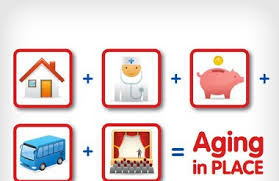
Who doesn’t want to live in their 'forever' home? After all, AARP has surveyed us for 2018 – staying there is apparently what 76% want, though only 59% expect that they will.  But responders also know that you can’t always get what you want. Concerns included the need for transportation regardless of physical status, ability to stay active in the community, and availability of hospitals nearby (though that 911 call can fail to find us).  And no, ride-sharing and self-driving cars are not viewed as panaceas.  We know many of the reasons older adults will leave their homes – families and the draw of grandchildren pull them nearer; a spouse dies; the home itself is too costly to keep.  

Why doesn’t senior living look like a more viable option?  The senior living industry has been in various stages of denial for years – in good times, overbuilding and in bad times, failing to effectively expand services to those aging in their communities.  Meanwhile, the average $3750/month costs of senior living communities are daunting to a population that may not have saved enough to support that choice. Seniors are aware of well-publicized life expectancy at 65 and 75. Consider a nationwide average $3750 cost (good luck finding an actual cost), that would amount to $675K over 15 years – for one person.

Will we stay -- or will we go?   Assume baby boomers put our proverbial feet down – we just will not leave -- and nothing can make us. What should we have in (or do to) our homes that facilitates ‘aging in place?’ Can a home that is far away from family members really be modified and then outfitted to help us stay there and stay connected? Should it be? The AARP survey reveals hope but uncertainty – and a strong possibility of changing locations. Ironically, that new location may not be moving in with the kids. The growth in 55+ housing is steady – is that where baby boomers will want to go if they can?

Fixing to stay – what enables aging in place? Technology plays a useful but tangential role. Sensors are helpful, fall detection is helpful, video cameras and online connectivity – they are all helpful and may reduce social isolation and loneliness. But as the holidays approach, tickets are bought and everyone seemingly travels. Adult children look at the homes of their parents and think more about their own homes -- and wonder.  Are these homes (ours, theirs) near public transportation, so limited in the suburbs?  Are the homes single-story (desirable, possible), available in 76% of US housing units -- but in few suburban developments?  How about night-time outdoor safety of walkways covered with ice or slippery with rain? What about walking a dog or tripping over the dog inside the house? 


from Tips For Aging In Place https://www.ageinplacetech.com/blog/aging-place-big-talk-do-people-really-believe-it

Wednesday, October 31, 2018

Five new technologies from LeadingAge Philadelphia 2018

From AAHSA to LeadingAge.  In 2010, this association was renamed LeadingAge – from the Association of Homes and Services for the Aging – a mouthful, shortened to AAHSA. As it was at first encounter in 2009, it is an association of faith-based and non-profit senior living and aging-related services. A rhetorical question, does LeadingAge, the association and event organizer, lead in the world of aging services? 

Or is it dragged into the future, one which older adults do not necessarily want – and also cannot afford?  From the 2016 event, attended by 6500, attendance had shrunk from 2009’s attending 9000. Meanwhile, the ‘aging in place’ concept is a reality for most older people. A small percent live in nursing homes. Most don’t move to senior living communities, which have been overbuilt in recent years -- and today are only 86% occupied.

What else should LeadingAge do? Consolidate with home care associations, for one, since that seems to be the more likely service providers for the oldest who cannot afford to move into LeadingAge companies. Consider more about virtual senior living – marketing services to individuals still living in nearby communities. Partner with the Village to Village Network with 200 active villages and many others launching. Include the larger population of service providers, not just its own members, in its 'consumer' online search for services, for another.  The Philadelphia event hosted a simulated Day in the Life that included Hamilton Captel (tech for hearing impaired) and VR startup Embodied Labs. The show also had a Startup Garage – here are five companies from that section (material from their websites):

  • Keenly Health. "Using state-of-the-art Ultra Wide Band (UWB) radar, Keenly Health intelligently monitors vital signs and patient activities to provide a distinctive window into a resident’s current and future health state. Keenly Health’s Big Data platform will analyze and compare gathered data continuously and quickly detect changes and trends to help identify exacerbation of chronic disease and help avoid the development of complications such as pressure ulcers, falls, and infections." Learn more at Keenly Health.
  • MyFrontPageStory.  "MyFrontPageStory.com brings the stories of everyday heroes to life. We specialize in telling stories about great people and turning them into their own personal newspaper front page. We have a team of professional journalists who conduct interviews and write feature-length stories that honor loved ones and celebrate major life milestones." Learn more at MyFrontPageStory.
  • OneClick.chat. "OneClick.chat leverages video chat technology to increase social engagement opportunities for seniors.Our platform can help you build trust, respond to questions, and create a space for real conversations. Create a room to connect directly with your community,or connect your community with each other."  Learn more at OneCLick.chat.
  • SofiHub. "Sofihub is an IoT (Internet of Things) device that contains AI (Artificial Intelligence that connects to sensors in our senior's homes. The systems "learns" the senior's behavior and will send an if something out of the ordinary happens in their home. In addition, Sofi will provide morning greetings, medication s and family communication."  Learn more at SofiHub.
  • SoundMindInc.  "Customized devices and personalized voice assistants to easily access the internet, relevant information, entertainment, communication, and more, simply by speaking. Connect the Dots brings the modern convenience of voice assistants to senior living. It gives administrators and caregivers tools to manage everyone's account and deliver personalized calendar information, reminders, messaging, and entertainment to residents all on one secure and easy to platform." Learn more at SoundMindInc.


from Tips For Aging In Place https://www.ageinplacetech.com/blog/five-new-technologies-leadingage-philadelphia-2018

Tuesday, October 30, 2018

Voice First and Health – What’s notable and not so much?

You probably knew this – that 2018 was the year of voice tech and healthcare.  Summits were held, experts have declared, pilots were piloted, partnerships formed, enthusiasm reigned, and so it has gone. As for 2019, according to Sara Holoubek, CEO of Luminary Labs, "expect a proliferation of bad voice experiences." 

C​onsider the healthcare experiences we have endured – it’s a good time to consider a new way to interact with the health system. From a technology perspective, what is each players doing to help us use our voice to have a better health and patient engagement experience?   Are any of these initiatives tuned to the needs of older adults?

Amazon Alexa:  They’re building a health and wellness team, and can list more than 1000 health and wellness skills, though only 13 pop up that are loosely related to older adults.  Observers have high hopes, both for Atul Gewande’s role leading the Amazon – Berkshire Hathaway – JP Morgan Chase partnership – and for ways Alexa can assist patients and doctors, maybe considering Suki for Doctors, the model of KidsMD or its partnership-based Flu Doctor Skill.  Caring for children is moving right along – how about more for the elderly, who consume so much more healthcare?

Google Actions/Assistant:  Google is already perceived by some as better at answering questions via Google Assistant. Google offers a long list of assistance with health and medicine questions, fitness exercises and tips, and symptom checkers.  It also has powered Doctor.com, which offers MDs assistance with practice management. The Google Assistant Investment Program has placed an undisclosed amount into Aiva Health, using voice to "empower patients and seniors, but also to connect them more closely to their caregivers." 

Siri, Cortana, Bixby – not much positive news yet:  Siri is rich in apps, but short on voice enablement of them, not long ago, Apple introduced Siri shortcuts -- enablers to easily access by voice what you do most often, according to observers, not yet  a match for Google Assistant or Alexa.  Cortana has enabled a few skills that are also available on Alexa and Google, like AskMyBuddy.  As for Bixby, its features can be integrated with Samsung Health (Mobile First) – for example, activity stats.  However, for Voice First, Samsung is biding its time, okay with being Voice Second or even Third.


from Tips For Aging In Place https://www.ageinplacetech.com/blog/voice-first-and-health-what-s-notable-and-not-so-much

Wednesday, October 24, 2018

Five Upcoming Aging and Technology Innovation Events

Go forth and network this fall. Especially for startups, but useful for long-time members of the field, going to events can reveal contacts that you may need or initiatives that you did not know existed. Over next few months, there are a number of events around the country that are worth attending if schedules permit and interest areas match. Useful, besides sessions themselves, are exhibit areas where vendors offer new and existing solutions for the target audiences of the attendees.  For those who cannot attend, check the exhibit hall online after the event if the organizers make that feature available.  Here are five events upcoming – the information provided from the websites of the organizers:

Leading Age, Philadelphia, October 28-31. "Make your plans to join us for the 2018 LeadingAge Annual Meeting and EXPO, where you’ll join other dedicated professionals to exchange ideas, explore new strategies and master the latest best practices all while reigniting your commitment and dedication. You’ll engage directly with colleagues to share, inspire and learn from one another, all in four productive days. Let’s work together to be more nimble, better serve our country’s older adults and best prepare for the upcoming changes in our field. LeadingAge is the trusted voice for aging—seize this opportunity to add yours." Learn more.

Aging 2.0 Optimize, San Francisco, November 14-15. "Get smarter, faster. We’ve thought through every moment of the Aging2.0 OPTIMIZE experience so that you can get the most value in the most efficient way. Hear about the lay of the landscape, proven best practices, upcoming trends and who’s getting traction in the space. We’ve designed A) a main stage program with powerhouse speakers that will cover the most critical and timely topics B) an exhibit space to showcase the leaders in innovation and aging and C) targeted networking time so that you can make the connections you need to grow your business. If you’re going to take time out of your busy schedule to go to one conference this year, we hope it’s OPTIMIZE." Learn more.

The Gerontological Society of America Meeting, Boston, November 14-18.  "The national professionals in the field of aging the opportunity to learn the latest trends and development from industry leaders, build strategic partnerships to address aging challenges, and network with peers. GSA’s 2018 Annual Scientific Meeting will take place November 14-18, 2018 at the John B. Hynes Veterans Memorial Convention Center in Boston, Massachusetts and will focus on the theme, "The Purposes of Longer Lives" chosen by incoming GSA 2018 President, Dr. David Ekerdt, University of Kansas." Learn more.

Aging Innovation Challenge, New York, November 29. "New York college students are competing in the Aging Innovation Challenge to develop a technology to help older New Yorkers remain independent and age in place. On November 29, five finalists will present their prototypes at a live event in New York City to compete for the grand prize and you are invited! See top innovations, network with industry experts in aging, technology, engineering, and health, and support young entrepreneurs as they showcase their innovations. An expert judging panel will evaluate the five finalists' innovations to determine which team will be named the winner of the first-ever Aging Innovation Challenge presented by New York State Department of Health and HeroX." Learn more.

Innovation in Longevity Summit, Washington, December 10-11. "Join us for a brand new event focused on the global innovation opportunity in the longevity market. With more than 90 years of combined experience and 35 national events, we’ll reveal new learnings about the five key levers for success in this trillion-dollar global market. Innovation in the booming longevity economy can create dramatic savings, and new models for thinking about aging – for state, local and federal government, nonprofit partners, and companies. Learn what these are and how they contribute to the bottom line."  Learn more.


from Tips For Aging In Place https://www.ageinplacetech.com/blog/five-upcoming-aging-and-technology-innovation-events

Monday, October 22, 2018

Help Yelp serve families with information about nursing homes

​Consider CMS Five Star Rating system and how it ‘serves’ families.  Rant on.  No doubt you know someone who was baffled at how a terrible nursing home gets a 4 or 5 star rating from CMS’s Five Star Rating System, while a good one can appear to have a lower rating, applied from an inspection before management overhaul several years earlier.  Why, you ask? Indeed.  Others have asked as well – noting the obvious missing link, family satisfaction with the nursing home, including dealing with the staff. For starters. Retiring outdated information, next. 

What’s a consumer to do? Well, for review of data accuracy, you can forget about Caring.com – in which you see a review of one facility yet find a different one discussed in the content.  No oversight of this section, which by now, 11 years after its founding, could have become an enormously valuable resource.  Let’s say a nursing home is known to be a real ‘pit’ and the lowest of the low -- as a friend notes who from the non-profit that takes complaints about nursing homes. Let’s check that rating from CMS Nursing Home Compare – 4 star, you see. Bummer.  And you can forget about rating -- aka marketing -- sites that ask for your email address and phone number before letting you see the ratings, including, but not limited to A Place for Mom. 

Over at Yelp – it is all about feedback.  As with restaurant reviews, what you say about a nursing home is as important as the other particulars about it. USC researchers looked at Yelp reviews – and noted that the intangibles matter to families. No kidding.  And that what Nursing Home Compare measures may be necessary, but not sufficient.  And without seeking updates and culling of rusting assessments, Nursing Home Compare may be worse than useless. Desperate family members, trying to find a place for parents that were ejected from assisted living, are stuck with a federally-funded repository filled with data, but no information. 

How can Yelp be enriched with more reviews?  Why should an $8000+ per month nursing home have less online feedback than a pizza restaurant? Consider the pain and rage in reviews when families and loved ones have a bad experience – where is that in nursing home compare?  See for yourself – a randomly selected nursing home in Queens called The Grand has a five star rating from CMS.  Now read the 20 reviews from Yelp.  You, your family, your clients, know of a nursing home (or other senior care provider), of course, that is at one end of the scale or the other.  Help Yelp – write a review – and no need to put in your phone number! Rant off.


from Tips For Aging In Place https://www.ageinplacetech.com/blog/help-yelp-serve-families-information-about-nursing-homes

Friday, October 19, 2018

Five Offerings from the Boston Connected Health Conference 2018

​Held each year – but has much changed? The Connected Health Conference is still a Health IT conference, owned by HIMSS, spruced up by the pre-conference Voice Health summit, task forces, and even onstage singing by health tech folk that may wish they were in show business. There were more sessions acknowledging caregiving and an aging population. But many attendees (also exhibitors) seem still to be circling the health care universe from the vantage point of the IT buyer -- health IT consulting, tech vendors seeking health IT customers. And vendors trying to nurture innovation, one not-so-integrated healthcare and engagement process at a time.  New offerings appearing at this event include (material is from the company sites):

Circulation: Circulation is the first customizable, patient-centric digital transportation platform that seamlessly integrates with both healthcare systems and health plans, and delivers a full suite of on-demand ride options including TNC, door-to-door, wheelchair and stretcher. Our founding team, staff, investors, and strategic partners represent expertise and leadership from organizations like: Humana, LabCorp, Intermountain Healthcare, Boston Children’s Hospital, athenahealth, Harvard Medical School, Flare Capital, and Echo Health Ventures. Learn more at Circulation.

Coral Health: Founded in 2017, Coral Health is a technology company that is building a more connected future in healthcare by enabling secure, real-time, shared access to validated medical information. At the heart of our system is a cross-platform, personal health records app that uses SMART on FHIR to provide users with seamless access to all of their health records. We allow individuals to share access to their data to improve care coordination and fuel a vibrant ecosystem of third-party digital health applications. Learn more at Coral Health.

Groove Health:  Groove Health is a healthcare data company focused on increasing medication adherence through predictive analytics and patient engagement. We partner with healthcare enterprises to provide value-added analytical insights and targeted outreach programs that increase medication adherence rates in chronically-ill populations. Learn more at Groove Health.

Mevia: Eva is designed to support the adherence in patients using oral medication. When the user takes a pill out of the packaging, the corresponding electronic trace breaks and the device transfers the data in real time to the user's App and/or your Hub. In addition to allowing a follow-up of the adherence behavior of every user, the Mia Hub crunches the numbers for you and transforms raw, individual adherence data into actionable insights. Learn more at Mevia.

Medisante: Medisanté connects caregivers to patient-generated health data (PGHD) for chronic conditions such as diabetes, hypertension, cardiovascular and overweight indications - timely and seamlessly, including support of devices with 3G connectivity. Once the targets of the care plan have been set by the caregiver, pre-built algorithms and event-based notifications allow caregivers to respond to the most critical cases, regardless of the patient's location. Learn more at Medisanté.


from Tips For Aging In Place https://www.ageinplacetech.com/blog/five-offerings-boston-connected-health-conference-2018

Sunday, October 14, 2018

Ten Tips for Launching a Product or Service – October, 2018

It’s 2018 and in full sprint to the year-end finish. Soon you will launch a boomer/senior, home health tech product or service, or maybe a caregiver advisory service.  As your company get ready to travel into battle or a booth this fall with the sound of lively pitches, it is time to for you to revisit this guidance. Perhaps some time soon, your new or existing company will officially launch a new product or service, or perhaps a long-awaited, over-described and much-anticipated offering will finally ship. First read existing content and research reports on your particular market segment.  Then look over this updated checklist that continues to hold true – with updated links and references. If necessary, refine tactics:

1) Is the website crisp and clear? Start with the home page that has modest and friendly graphics and images (not a ransom note with 27 different font size and colors) to identify what the product or service does or is. Don't lead with fear-generating images or force the viewer to start with a video. Skip paragraphs of narrative-laden terminology to wander through before it is apparent what the product or service does. Nor does the reverse make sense -- a single graphic, with an interface designed only to be viewed on a smartphone. Make sure to specify how it works, for whom, with multiple tabs for multiple markets, and device-appropriate viewing. To encapsulate the impact of a product, videos of actual use are best. 

2) With every new launch, is there a press release? A single release is inexpensive on Business Wire or PRNewsire -- content that will surface on newly-created Google alerts long after the launch date.  Not a PDF file, not a Word file, but a viewable (online) press release with links, kept under 1 page, that is found under your website category of PRESS, MEDIA or NEWS. Descriptive titles are a must -- multi-line titles are ridiculous. To be perceived as an ongoing concern and not have viewers speculate about whether the company is still in business, a press release should be issued for every significant business change, including new executives or customers, moves to new offices, etc., with at least one in the past 3-4 months.

3) Are executives identified in 'About' the company? What's the point of keeping the identities of founders and executives a secret unless there's something to hide? This is as true of offerings that sell through resellers as those that sell direct. (For an example, see an About Us that is not, uh, About Us.)  There is absolutely no reason to have to search Google or send e-mails to Info@XYZ - co.com in order to find out who is running the place or tease out that XYZ- co.com is actually a subsidiary of GIANT - CO.com or to call in order to find out that the real service is provided by another company, not identified on the website. 

4) Pre-brief an industry analyst and the media.  Especially if the product will be launched at a trade show, pre-show briefing of an analyst enables the firm to refer reporters to the analyst to understand where the offering fits in an industry or for just for press quotes that could be included in a launch press release  In addition to pre-briefing, if there is a PR firm (or even if there isn’t), contact a local news site and see if they’d like to learn more about a home town entrepreneur – with a great new offering that they (or their families) need to know about. 

5) Is the actual product or service going to be available near term?  What’s that mean? By the official launch date, some stages of evolution are complete or within a few weeks of completion. For example, there's a working prototype (i.e. no known installation or operational defects); there are identified manufacturers; committed partners; an initial pilot is completed to validate usefulness; the pricing is clear; power requirements are clear; the software works; the product registration and installation processes have been established and validated. It's not okay -- and I would argue a waste of money – if the actual launch date is an unknown or l-o-o-n-g number of months later. Momentum is lost, especially if the reason for the delay is that the pilot revealed that it doesn’t work yet.. Pre-orders seem to be all the (Indiegogo) rage as a marketing tactic -- hopefully the ultimate offering on whatever date doesn't result in the rage of missed expectations, or a nasty review on an Amazon website.

6) Software vendors -- design with market input (not your grandmother!). Prospective B2B buyers are jaded -- they've seen many variants of software, for example, for home care services, senior housing, or non-profit segments. Although it may have seemed that way in 2016, these are not industries ready for 'if we build it, they will come'. And I hear too many entrepreneurs say the following: "In my personal experience, my family had issues with (fill in the blank) with my own (grand)parents, therefore my offering will address those issues by (fill in the blank)." For most participants in the age-or care-related industry, a personal experience underpins enthusiasm to be in this emerging space. If that is a given for your company, shake it off -- validate prospective value through interviews, surveys, and follow with software design or website walkthroughs -- before casting the solution into the concrete of release-ready code.

7) Service providers -- what's different, who will buy, at what price, where do they live?  With an inbox filled with "we are introducing a new service for (pick one -- finding caregivers, housing, helping families, seniors) that will be the first comprehensive guide/service to (fill in blank)". But really, there is no need to do a nationwide media launch of a service that is initially only available within a single geographic region. On the flip side, if the service is in the process of nationwide expansion, call or stay tuned – maybe your product fits into the service or ecosystem.

8) What's that product or service category, anyway? It helps those who might want to accurately position what you're doing -- and this includes press, analysts, investors, prospective partners and resellers -- to understand the category placement and not have to inquire amid a sea of obfuscation and inappropriate terminology. Is this a home health care service or a companion care service? They are licensed differently -- does the firm offer both, at different prices? Is this a tool for chronic disease management (not exactly 'wellness') or is this one for tracking a fitness regimen (sounds like wellness)?  Finally, as with fall detection, is this product really a feature of other products or is it viable on its own as a solution? As with a new variant of sensor-based home monitoring, is this a category, even if it is renamed IoT? And if this is the revival of a previous movement, like smart homes, why are new-aged versions less intrusive, more robust and secure than previous home security/automation?

9) PR team, this means you. Before scheduling a briefing, please do the research in case your clients don't tell you much.  In the category of baffling, I've received requests to brief me about a vendor, an offering, a launch that I've already written about or mentioned for months. Just because it's Day One for you, the PR firm, and you're excitedly new to this space, doesn't mean that your client and offerings are heretofore completely unknown. Please search the Internet first. Perhaps you are helping to inform about a new release, and the news is actually new. Or it is not new, just repackaged. Just know what has preceded it -- and build upon prior activity. Anything else reflects poorly on the company that hired you. It can’t hurt to read up on briefing analysts.

10) As for the non-launch launch, what if market interest happens anyway? Can you offer up a customer or user to interview, can you say how your offering fits into the marketplace (current use of your product, who are other players, market size if available, and target audience)?  And most important, can someone in this very needy market actually buy that robotic cat? (Good answer: Yes).  If you're not ready, say you're not ready. You know that there is a gap in capability in your target market and your company is just the right company to fill that gap -- and even better, do it with software on an existing hardware or software platform. No need to rush or launch too early -- because that's the thing about an emerging market to serve an aging population. The customer segment will be around for a long time. Let's not disappoint them.

Hope to see you at upcoming events in Boston, Washington, Las Vegas and Chattanooga!

[To read more about this topic, click on Aging in Place Technology Watch]


from Tips For Aging In Place https://www.ageinplacetech.com/blog/ten-tips-launching-product-or-service-october-2018