
Showing posts with label Tips For Aging In Place. Show all posts

Wednesday, February 3, 2021

Care options for seniors...tech included

Aging in place – it’s emerged (again) during these Covid-19 times. Déjà vu all over again. But ‘aging in place’ is still a challenge and maybe a pipe dream for seniors in their late 70’s or 80’s.  Consider a few issues for starters:  chronic health conditions including mobility limitations, stairs, snow/ice, driving, dangerous hills for walking, cognitive issues, and social isolation.  You get the idea.  Then there is the cost of 24x7 home care, same as assisted living (which is $67K in Massachusetts, for example) or even Genworth’s 44-hours of home care ($53-54K annual).  That may work for the most well-to-do seniors.  But families are still in a position of finding and then managing the care workers, even with agency assistance. So Mom or Dad stays at home as long as feasible and even beyond – and that’s why the home care industry today is booming. And competing for the same workers as senior living firms pay their CNAs. 

Senior living – maybe the pitch is about providing care. The irony! Forever, it seems that the senior living sales pitch has been about the variety and quality of food, the beauty of the décor, and the plentiful ‘lifestyle’ activities.  This mythology persisted, even as the average age of residents rose into the mid-80’s, frailty of residents increased (note the need for help with bathing). Dementia care (note percentages with various levels of dementia), by 2019 a much-needed offering. Consider the role of the LPN nurse -- calling 911 to bring residents to the ER for all but the simplest condition. But in a recent interview, one executive noted the pitch has migrated to selling care:  “Sales and marketing teams did not focus as much training on the care component, pre-pandemic, which caught many flat-footed when general inquiries into the product took a nosedive.”  And now some make the case for an onsite  RN, not an LPN.

Are nursing homes going to disappear? Unlikely. It’s one thing to read the appropriate coverage in the media about the horrendous mismanagement of Covid-19 patients in New York City nursing homes. But does mismanagement and fact obfuscation about death rates guarantee the industry’s long-term ‘grim future’?  Even if assisted living organizations hire an RN, offer dementia care, and change their marketing strategies, some seniors will end up in in one of the 14,000+ US nursing homes. Perhaps the reasons could be the Medicare-paid post-acute rehab care, in-room wound and IV treatments, and Medicaid-reimbursed daily rate.  Perhaps the assisted living staff or the senior’s family could no longer handle the older adult who may have significant care requirements. Perhaps many years in assisted living consumed family assets and an elder law attorney helped with the move to a Medicaid-eligible nursing home?   

No matter where older adults live, technology capability matters.  Older adults need to get and stay connected via broadband.  And when another distressing survey says that 22 million seniors don’t have it, that isn’t going to work.  Broadband enables signing up for vaccine appointments, finding home care, getting meals delivered, learning a skill, seeing family members, and finding a job. Since the telecom carriers don’t seem to be closing this enormous gap, it’s time that some national entity focused older adults living in their own homes gets it done. Senior living needs to get it done – for an example – see the home page featuring technology depth for Asbury Communities.  Skilled nursing facilities need to work with payers to a) upgrade to broadband; b) enable families and outside organizations to connect with residents; and c) combine with healthcare services like teledentistry and permanently make telehealth available to all residents.  



from Tips For Aging In Place https://www.ageinplacetech.com/blog/care-options-seniorstech-included


Tuesday, February 2, 2021

Let’s talk about care options for seniors – shouldn’t technology be a part of care?

Aging in place – it’s emerged (again) during these Covid-19 times. Déjà vu all over again. But ‘aging in place’ is still a challenge and maybe a pipe dream for seniors in their late 70’s or 80’s.  Consider a few issues for starters:  chronic health conditions including mobility limitations, stairs, snow/ice, driving, dangerous hills for walking, cognitive issues, and social isolation.  You get the idea.  Then there is the cost of 24x7 home care, same as assisted living (which is $67K in Massachusetts, for example) or even Genworth’s 44-hours of home care ($53-54K annual).  That may work for the most well-to-do seniors.  But families are still in a position of finding and then managing the care workers, even with agency assistance. So Mom or Dad stays at home as long as feasible and even beyond – and that’s why the home care industry today is booming. And competing for the same workers as senior living firms pay their CNAs. 

Senior living – maybe the pitch is about providing care. The irony! Forever, it seems that the senior living sales pitch has been about the variety and quality of food, the beauty of the décor, and the plentiful ‘lifestyle’ activities.  This mythology persisted, even as the average age of residents rose into the mid-80’s, frailty of residents increased (note the need for help with bathing). Dementia care (note percentages with various levels of dementia), by 2019 a much-needed offering. Consider the role of the LPN nurse -- calling 911 to bring residents to the ER for all but the simplest condition. But in a recent interview, one executive noted the pitch has migrated to selling care:  “Sales and marketing teams did not focus as much training on the care component, pre-pandemic, which caught many flat-footed when general inquiries into the product took a nosedive.”  And now some make the case for an onsite  RN, not an LPN.

Are nursing homes going to disappear? Unlikely. It’s one thing to read the appropriate coverage in the media about the horrendous mismanagement of Covid-19 patients in New York City nursing homes. But does mismanagement and fact obfuscation about death rates guarantee the industry’s long-term ‘grim future’?  Even if assisted living organizations hire an RN, offer dementia care, and change their marketing strategies, some seniors will end up in in one of the 14,000+ US nursing homes. Perhaps the reasons could be the Medicare-paid post-acute rehab care, in-room wound and IV treatments, and Medicaid-reimbursed daily rate.  Perhaps the assisted living staff or the senior’s family could no longer handle the older adult who may have significant care requirements. Perhaps many years in assisted living consumed family assets and an elder law attorney helped with the move to a Medicaid-eligible nursing home?   

No matter where older adults live, technology capability matters.  Older adults need to get and stay connected via broadband.  And when another distressing survey says that 22 million seniors don’t have it, that isn’t going to work.  Broadband enables signing up for vaccine appointments, finding home care, getting meals delivered, learning a skill, seeing family members, and finding a job. Since the telecom carriers don’t seem to be closing this enormous gap, it’s time that some national entity focused older adults living in their own homes gets it done. Senior living needs to get it done – for an example – see the home page featuring technology depth for Asbury Communities.  Skilled nursing facilities need to work with payers to a) upgrade to broadband; b) enable families and outside organizations to connect with residents; and c) combine with healthcare services like teledentistry and permanently make telehealth available to all residents.  


from Tips For Aging In Place https://www.ageinplacetech.com/blog/let-s-talk-about-care-options-seniors-shouldn-t-technology-be-part-care

Monday, February 1, 2021

Aging and Health Technology blog posts from January 2021

Time for the Market Overview Technology for Aging 2021. It’s a new year and the baby boomers turn 75. It took the combination of 73 million boomers, a pandemic emergency, and the sheer size of the aging population to transform a 2009 market niche into this 2021 market category worthy of investment-- less about products specifically designed for older adults as it is about the marketing of many existing offerings as useful to them. But this is January, 2021, in the time of Covid-19 and the time of the all-digital Consumer Electronics Show -- this time with at least 70,000 online attendees from around the world and the tech industry -- and so new companies are surfacing with technologies that will generate interest and even excitement during 2021. Learn more.

Ten technology offerings for older adults from CES 2021. CES 2021 – roll the press releases and turn on your computer. A long time ago, one writer published a charmingly-named CES overview of CES 2012 called CES in Pajamas – an entertaining read with links to 2012 videos just to see what flopped, what was canceled (remember Microsoft Kinect?) and what/who is still around. Laptops were hot (remember the Ultrabook?) Voice First and the Apple Watch had not emerged. Oh well. Fast forward to 2021. Pajama-like clothing is the only way to consume the content vastness of this entirely online Consumer Electronics Show with 500 exhibits, 70,000 registered attendees, and 3 full days of sessions, many pre-recorded, some live. Too many press releases and some odd stuff (a rollable Smart phone?) Here are a few useful to older adults, alphabetical from firm sites. Learn more.

Even online – it was still CES – more, from the silly to interesting to useful. How many of these exist? An international conference where inventions from everywhere are welcomed. Some of these offerings, as always, are odd. But some, as with yesterday’s CES 2021 blog post, are quite straightforward and obviously useful. Others require a leap of imagination or a good explanation as to why this variant of hearing aid is worth as much as $4000 per ear. As always with CES, some capabilities are interesting and have future potential – and some are just too cute for more words. Learn more.

What is broadband and why should seniors want it? The buzz about broadband and older adults has grown louder since the start of the pandemic – which worsened social isolation for so many older adults. A just-released report sponsored by the Humana Foundation and OATS called Aging Connected, made the case that nearly 22 million seniors (age 65+) lack wireline broadband access at home. Not a surprise -- that follows other reports over the past year or two like Pew (2019), which noted that only 59% of the 53.7 million aged 65+ have home broadband. Learn more.

Older adults and broadband in 2021. This new report has a point of view -- despite surveys that indicate that people use their smartphones (wireless versus "wireline") to access the Internet, truncated screens can be problematic. The report notes difficulty with financial and document management/editing – as well as limitations in using social networking and engagement technology. Issues have often been noted which act as as barriers to accessing services like telehealth for example. In fact, lack of access to a portal for vaccine appointments has recently emerged as a new broadband divide.  Learn more.


from Tips For Aging In Place https://www.ageinplacetech.com/blog/aging-and-health-technology-blog-posts-january-2021

Thursday, January 28, 2021

Older adults and broadband access -- picking up the pace of adoption

What is broadband and why should seniors want it?  The talk about broadband and older adults is growing louder since the start of the pandemic – which worsened social isolation for so many older adults. A just-released report sponsored by the Humana Foundation and OATs called Aging Connected, made the case that nearly 22 million seniors (age 65+)  lack broadband access at home. Not a surprise -- that follows other reports over the past year or two like Pew (2019), which noted that only 59% of the 53.7 million aged 65+ have home broadband -- another term for High Speed Internet Access (HSIA).  This new report has a point of view -- despite surveys that indicate that people use their smartphones to access the Internet,  there is a great deal that is problematic on a smartphone where screens are truncated – including financial and document management/editing – as well as limitations in using social networking and engagement technology.  So issues have often been noted that act as barriers to accessing services like telehealth for example. Awareness and access to vaccine appointments has recently emerged as a new broadband divide.

So why isn’t more of the older adult population connected? One issue is cost which can be prohibitive to many older adults. And cost is itself is related to lack of competition. In the 2020 OTI report, The Cost of Connectivity, researchers examined 296 data plans in the US, finding that only 64 of them meet the FCC definition of broadband.  According to the report, most of the US plans are in places that lack competition, leading to high prices and hidden fees. In-home and high-speed access to the Internet is still elusive for many in the US.   AARP encouraged access as early as 2013. The Federal Communications Commission (FCC) has express its concern and launched a "Get Connected to broadband" page in 2018. But their theory, that older adults were technology phobic (while perhaps true of some), did not address the lack of competition which correlates with price. The US ranks poorly in the cost of broadband, with a number of apparently less-wealthy nations costing less than the US average of $57 per month -- lower than 2019's $72/month bill.  

Who (what) is trying nationally to close the broadband chasm?  Broadband access or lack of it boils down to significant differences in offerings and availability geographically. Private companies like AllConnect or Union Wireless offer broadband shopping and comparison sites. But to really change the status quo, there should be (should have been) a national broadband plan – begun in 2010 – that proceeded to deployment. But that didn’t happen. Another initiative was launched in March 2020 to improve the Broadband Data Maps, particularly concerned with rural broadband access, and which required the FCC to use the "newly-created maps when making new awards of broadband funding."  Unfortunately, it's too early to know if that has boosted broadband access for older adults.

Discounts help many – do they help older adults?  Emergency broadband access has been ramped up in the December pandemic stimulus -- $50/month – aimed to help a series of groups, including school aged children studying at home. These are paid to Internet Service Providers to encourage discounted programs, including the cost of providing equipment to the home. Despite that effort, the January 2021 Aging Connected report conclusion also observed: “As age itself is one of the largest determinants of home internet access, it should also be a primary focus. Collaboration from senior service providers, advocacy organizations and telecommunication organizations will also be essential.” Many older adults and those who help them are no doubt looking forward to see examples of that collaboration throughout 2021.


from Tips For Aging In Place https://www.ageinplacetech.com/blog/older-adults-and-broadband-access-picking-pace-adoption

Broadband connectivity and older adults -- what's now and ahead?

What is broadband and why should seniors want it?  The talk about broadband and older adults is growing louder since the start of the pandemic – which worsened social isolation for so many older adults. A just-released report sponsored by the Humana Foundation and OATs called Aging Connected, made the case that nearly 22 million seniors (age 65+)  lack broadband access at home. Not a surprise -- that follows other reports over the past year or two like Pew (2019), which noted that only 59% of the 53.7 million aged 65+ have home broadband -- another term for High Speed Internet Access (HSIA).  This new report has a point of view -- despite surveys that indicate that people use their smartphones to access the Internet,  there is a great deal that is problematic on a smartphone where screens are truncated – including financial and document management/editing – as well as limitations in using social networking and engagement technology.  So issues have often been noted that act as barriers to accessing services like telehealth for example. Awareness and access to vaccine appointments has recently emerged as a new broadband divide.

So why isn’t more of the older adult population connected? One issue is cost which can be prohibitive to many older adults. And cost is itself is related to lack of competition. In the 2020 OTI report, The Cost of Connectivity, researchers examined 296 data plans in the US, finding that only 64 of them meet the FCC definition of broadband.  According to the report, most of the US plans are in places that lack competition, leading to high prices and hidden fees. In-home and high-speed access to the Internet is still elusive for many in the US.   AARP encouraged access as early as 2013. The Federal Communications Commission (FCC) has express its concern and launched a "Get Connected to broadband" page in 2018. But their theory, that older adults were technology phobic (while perhaps true of some), did not address the lack of competition which correlates with price. The US ranks poorly in the cost of broadband, with a number of apparently less-wealthy nations costing less than the US average of $57 per month -- lower than 2019's $72/month bill.  

Who (what) is trying nationally to close the broadband chasm?  Broadband access or lack of it boils down to significant differences in offerings and availability geographically. Private companies like AllConnect or Union Wireless offer broadband shopping and comparison sites. But to really change the status quo, there should be (should have been) a national broadband plan – begun in 2010 – that proceeded to deployment. But that didn’t happen. Another initiative was launched in March 2020 to improve the Broadband Data Maps, particularly concerned with rural broadband access, and which required the FCC to use the "newly-created maps when making new awards of broadband funding."  Unfortunately, it's too early to know if that has boosted broadband access for older adults.

Discounts help many – do they help older adults?  Emergency broadband access has been ramped up in the December pandemic stimulus -- $50/month – aimed to help a series of groups, including school aged children studying at home. These are paid to Internet Service Providers to encourage discounted programs, including the cost of providing equipment to the home. Despite that effort, the January 2021 Aging Connected report conclusion also observed: “As age itself is one of the largest determinants of home internet access, it should also be a primary focus. Collaboration from senior service providers, advocacy organizations and telecommunication organizations will also be essential.” Many older adults and those who help them are no doubt looking forward to see examples of that collaboration throughout 2021.


from Tips For Aging In Place https://www.ageinplacetech.com/blog/broadband-connectivity-and-older-adults-whats-now-and-ahead

Wednesday, January 20, 2021

Nine more older adult technology offerings from CES 2021

Even online – it was still CES – from the silly to interesting to useful.  How many of these exist? An international conference where inventions from everywhere are welcomed.  Some of these offerings, as always, are odd.  But some, as with yesterday’s CES 2021 blog post, are quite straightforward and obviously useful. Others require a leap of imagination or a good explanation as to why this variant of hearing aid is worth as much as $4000 per ear.  As always with CES, some capabilities are interesting and have future potential – and some are just too cute for more words.  Here are 8 more:

CareClever Cutii.  "Cutii is a Companion Robot for isolated seniors. Cutii is designed for friendship. It's a "live-in companion" that learns the design of the senior's room. Seniors communicate directly with Cutii. It's 100% voice activated and offers 2 way calling and text messages. Cutii can entertain and occupy the mind and body with live activities like Yoga, Tai Chi, poetry reading, games, trivia and so on." Learn more at Cutii.

ITRI Dual Arm Robot. "The Industrial Technology Research Institute in Taiwan developed a Dual Arm Robot System (DARS) that can perform different tasks for humans without specific tools. The robot features hands similar to humans with enough dexterity to even perform on a piano. ITRI said the system could serve in industries such as manufacturing, health care and hazardous environment operation." Learn more at ITRI.

Moflin. "Moflin is an AI pet robot with "emotional capabilities", and it looks like a fluffy gray guinea pig, with black beady eyes and soft fur. Vanguard Industries says that its unique algorithm allows Moflin to learn and grow, using built-in sensors to evaluate its surroundings. These sensors include accelerometers with gyroscopes, touch sensors, and microphones. That means its capable of distinguishing between different people depending on how they interact with it, and can express its 'feelings' accordingly, through movements and sounds that were inspired by real animal noises."  Learn more at Moflin.

Orcam Read. “For people with mild low vision, reading fatigue, reading difficulties including dyslexia, and for anyone who consumes large amounts of text. OrCam Read is a first-of-its-kind handheld device with a smart camera that seamlessly reads text from any printed surface or digital screen. It enables you to enjoy the morning paper, read any book, and even read all that appears on your computer or smartphone screen. Privately read the text that you choose, improve your time studying, work more efficiently." Learn more at Orcam.

Petit Qoobo. "One “uses” the Qoobo by placing it in your lap, where it will stay for as long as you like (again, unlike a real cat). Apparently, it is meant to behave something like a therapy animal, and the company wanted to emulate the “healing qualities” of a cuddly animal sitting on your lap and wagging its tail." Learn more at Qoobo.

Samsung Bot Handy.  "The Samsung Bot Handy is currently 'in development' but was shown working during CES 2021. This device works with 'advanced AI' to “recognize” objects by size, shape, and weight. The “handy” part of its name is for its ability to pick up objects, “becoming an extension of you and helping you with work around the house.” Samsung Bot Handy can handle dishes after a meal. You’ll wash each dish and put it in a rack for drying – this robot can pick up each dish and place each dish in your cupboard without any smashing." Learn more at Slashgear.

Widex Moment hearing aid. "MOMENT boasts a new feature called PureSound™, which Widex claims delivers a more natural sound than ever before. Widex describes PureSound as “an industry defining, ultrafast signal pathway that eradicates the unpleasant artefacts inherent in classic hearing solutions.” PureSound is related to another new feature, ZeroDelay™, which enables near-0ms sound processing across the entire frequency spectrum, also allowing for a more authentic listening. experience." Learn more at Widex.

Voy Glasses. “This week, eyewear company VOY Glasses, was awarded the 2021 Innovation Award in Wearable Technology at the prestigious Consumer Electronics Show (CES) for its Tunable Eyeglasses. The San Francisco-based company wanted to provide a solution to help people suffering from both farsightedness and moderate nearsightedness. The VOY Tunable Eyeglasses provide the solution with just one pair of glasses. They can change focus from -5D to +2D in a matter of seconds, eliminating the need to carry several pairs of specs with you. To adjust the lenses, the wearer simply adjusts the dials located on top of each lens – adjusting away from the nose for a more negative power or turn the wheel towards the nose for a more positive power.” Learn more at VOY.


from Tips For Aging In Place https://www.ageinplacetech.com/blog/nine-more-older-adult-technology-offerings-ces-2021

Wednesday, January 13, 2021

Ten technology offerings for older adults from CES 2021

CES 2021 – roll the press releases and turn on your computer.  A long time ago, one writer published a charmingly-named CES overview of CES 2012 called CES in Pajamas – an entertaining read with links to 2012 videos just to see what flopped, what was canceled (remember  Microsoft Kinect?) and what/who is still around. Laptops were hot (remember the Ultrabook?) Voice First and the Apple Watch had not emerged.  Oh well. Fast forward to 2021. Pajama-like clothing is the only way to consume the content vastness of this entirely online Consumer Electronics Show with 500 exhibits, 70,000 registered attendees, and 3 full days of sessions, many pre-recorded, some live.  Too many press releases and some odd stuff (a rollable Smart phone?)  Here are a few useful to older adults, alphabetical from firm sites:

AbsoluteAudio’s PYOUR Audio Hearing 2.0. This comprehensive software suite is built up from a range of proprietary algorithms, destined at restoring speech understanding and best music experience for people suffering from hearing damage or hearing loss. It consists of AAL's unique and unbeaten Advanced Noise Suppression, directionality algorithms, Instantaneous Wide Band Compression and Acoustic Feedback Cancellation. It is the only solution in the market that can support building hearing aids from premium consumer audio components, by pairing high quality hearing performance with extremely low power consumption and low memory usage. Learn more at Absolute Audio.

Aladin Smart Lamp. A smart lamp that hangs on the wall and anticipates and prevents falls of residents in assisted living and nursing facilities, Aladin uses artificial intelligence (not sensors) to detect changes in motion, temperature, and more. Its automatic lighting, built-in fall detector, and integrated monitoring system not only reduces falls but can decrease the stress on caregivers, allowing high-risk individuals to be independent again. Learn more at Domalys.

CarePredict TouchPoint. This product is a remote activity monitoring app for seniors. It provides caregivers with continuous insight and increased visibility into their loved one’s well-being. TouchPoint is the companion of another CarePredict product called Tempo, which is a wearable device, similar to a watch or wristband, designed to track subtle changes in a senior’s daily activities and behavior. Learn more at CarePredict.

iCardioGuard. "iCardioGuard detects heart rate and respiration in three seconds, records the measurements and transmits the collected data to a mobile device by Bluetooth. A mobile app then instantly displays the person's physical and psychological states and sends a warning notification when it detects irregularity. It also features ITRI's LPMS (Low Power Microwave Sensor) technology, which passed the FDA-level electromagnetic wave radiation EMC/EMI test by the IEC60601-1/IEC60606-2 regulation."  Learn more at ITRI.

The Core Kit.  App with sensors that track movement and patterns to provide family members/caregivers with reassurance that things are as they should be, without the use of invasive video cameras or wearable tracking devices. Small, non-intrusive sensors are placed discretely around the home, with insights for early detection of problems and see if there are changes in their eating, sleeping or activity patterns. Learn more at Caregiver Smart Solutions.

FallCall Detect.  “FallCall Detect's breakthrough technology distinguishes between falls with greater force that are more likely to cause injury and falls that occur from a sitting position. If a high-impact all is detected, FallCall's US-based medical monitoring service is automatically contacted* and will send emergency services if needed. If a low-impact fall is detected, only a user's pre-designated support community is contacted. For Apple Watch.”  Learn more at FallCall.

ianacare. "The free app serves as a point of coordination for a patient’s family and friend caregivers to organize tasks such as dropping off groceries, picking up medications from the pharmacy, virtual check-ins and emotional connections."  Learn more at ianacare.

MightyHealth. “Mighty Health’s product is focused on three things: live coaching; content focused on nutrition, preventative checkups and workouts; and celebrations that let family members tune into their loved ones’ achievements. The app has inclusivity built into its functionality. Everyday, a user logs in and gets a set of three to five tasks to complete, distributed among nutrition, exercise and workouts.”  Learn more at MightyHealth.

Omron VitalSight. “VitalSight may identify warning signs of a heart attack or stroke before they happen. This program is for everyone who takes their overall health seriously and wants to try to prevent a heart attack or stroke. The VitalSight remote patient monitoring program relies upon connected medical devices that enables patients to make a commitment to regular heart health monitoring from the comfort of their homes.” Learn more at Omron.

WellBe Medical Alert.  “HandsFree Health, rovider of WellBe®, a secure, HIPAA compliant, voice-enabled virtual health assistant platform, is offering the first fully integrated home health system for seniors to help them age-in-place. WellBe Medical Alert PLUS is an AI-powered system that includes both a voice assistant as well as a sleek smartwatch, connecting users with emergency services with their voice at home or via a watch button when on-the-go.” Learn more at HandsFreeHealth.


from Tips For Aging In Place https://www.ageinplacetech.com/blog/ten-technology-offerings-older-adults-ces-2021

Wednesday, January 6, 2021

From the 2021 Market Overview Technology for Aging

It's 2021 and baby boomers turn 75. It took the combination of 71 million boomers, a pandemic emergency, and the sheer size of the aging population to transform a 2009 market niche into this 2021 market category worthy of investment-- less about products specifically designed for older adults as it is about the marketing of many existing offerings as useful to them.  But this is January, 2021, in the time of Covid-19 and the time of the all digital Consumer Electronics Show -- this time with at least 70,000 online attendees from around the world and the tech industry -- and so new companies are surfacing with technologies that will generate interest and even excitement during 2021. The entrants that can help older adults fit into categories like:

Smart displays, voice first interfaces will be ubiquitous. For older adults, touchless technology and voice-enabled interactions are ideal, especially when accompanied by a display of large font text and engaging videos. Why? Because it is easier for them – turning frustration into a valued service world in which what you say should get you what you need. Voice interfaces will be expected in smart displays and will be added to every feasible device (and new car) and gain widespread use in independent and senior living.

Hearing technology markets will be further disrupted in 2021. As it did in 2020, new hearing aids will make use of machine learning to enhance the quality of sound for the wearer. Lower cost hearing aid options including financing alternatives are now part of the mix. Expect hearables to further evolve; over-the-counter hearing aid purchases to be FDA-legitimized; retail and at-home self-service/self-fitting services expand (further enabled as a result of Covid-19), individuals with hearing loss may opt in to improving what they can hear in home and when out and about.

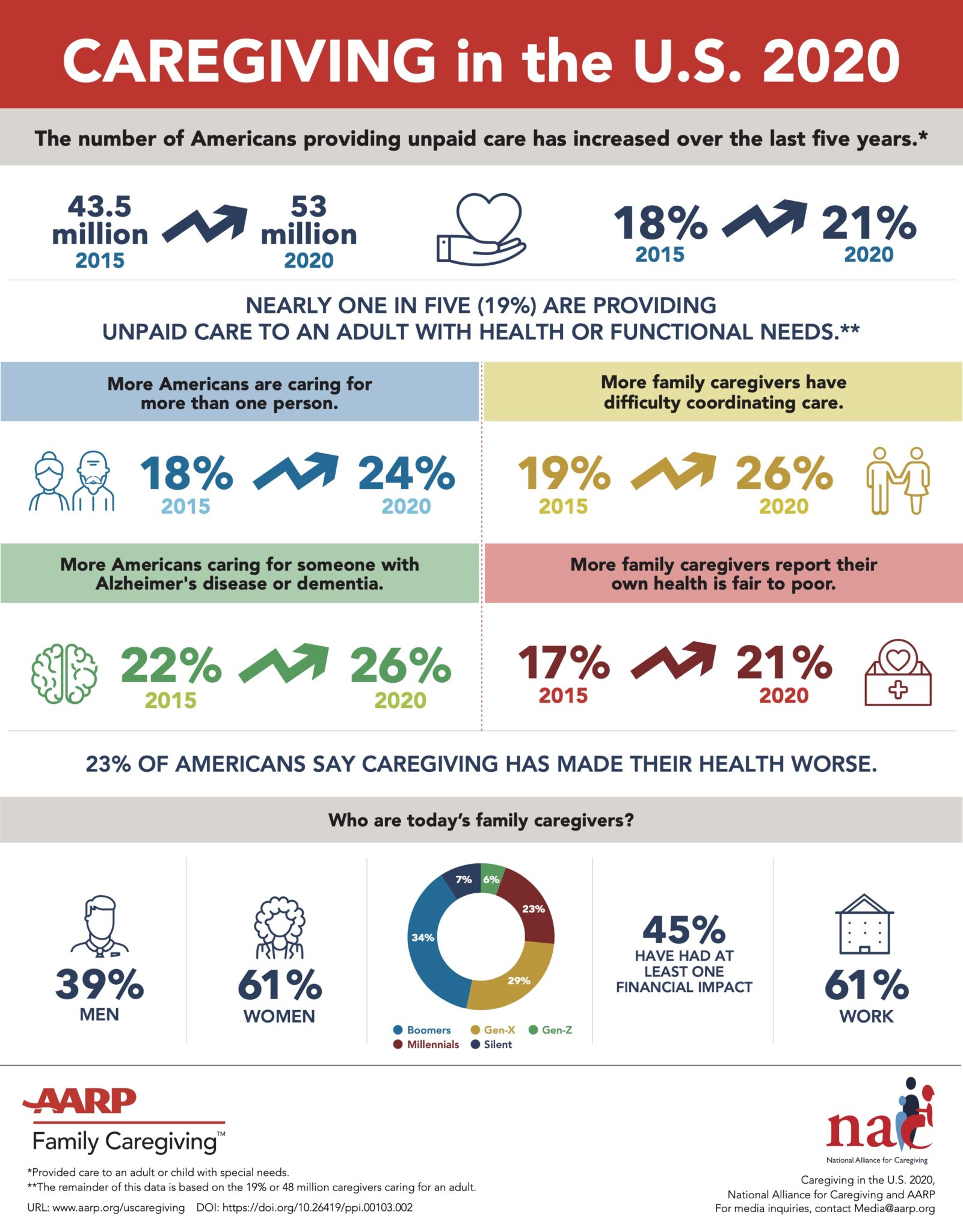
Caregiver shortages, prolonged isolation, and aging -- boost in-home monitoring. Fifty-three million Americans are providing care to someone with health or or functional needs – in short, they are family caregivers. The intersection of three simultaneous trends of aging alone at home, worsening caregiver shortages and turnover, and the percentage of adult children working, interest in monitoring technology in the home will grow, including in-home hubs that can manage web cameras, sensors, smart doorbells or enable voice-first emergency response,

The absence of widely available tech training and support should prompt innovators. It’s not just seniors who need help. The proliferation of devices and their non-simplicity gave birth to Best Buy’s Geek Squad into Total Tech Support (any device) and $10 million of funding for learning platforms.. New technology requires training and support – and profit for companies that can deliver it cost effectively. With the aging of baby boomers, newer offerings like Support.com (any connected device) will tailor messages to reach an older adult audience. Expect national organizations to put more focus on for older adults in 2021.

[This Market Overview will be posted on January 11, 2021, the week of CES 2021 and the Longevity, Health & Innovation Summit.]


from Tips For Aging In Place https://www.ageinplacetech.com/blog/2021-market-overview-technology-aging

Wednesday, December 30, 2020

Selected tech trends from upcoming 2021 Market Overview

Looking ahead to 2021 -- pre-CES, what trends will persist?  So that's just about enough of 2020 -- a year worth putting behind us, if ever there was one. Much creativity and stopgap solutions were the signs of the Covid-19 times.  There was an awakening about older adults as targets of ageism and victims of social isolation, true. But there was also an awakening to the significance of aging in place, the investment category of older adults, the market power of older adults, including the 65+ population of 54 million. And who knew that the fastest growing subsegment was those aged 80+?  Innovators in 2020 helped mitigate social isolation, enable in-home strength training for seniors, provided the tech mechanics (regardless of infrastructure) to connect older adults to families? All that and more make up the new entrants in the 2021 Market Overview of Technology for Aging, to be published the week of January 11.  Some of the key trends:

AI is behind the scenes -- everywhere.  The availability of a growing trove of data about our behavior has enabled the ever-smarter world of voice interactions and sensors. But the accumulation of this behavior information over time enables analytics that will augment simple monitoring and alerts.  Pattern analysis, dashboards, and predictive analytics have permeated tech innovation for years, including healthcare, but have been slow to enter the world of caregiving for older adults.  That is changing – and new entrants offer tools that learn patterns of behavior to alert about issues that caregivers need to address. In 2021, this Internet of Behavior will emerge as a trend that serves older adults and those who care for them.

Wearables became more visible – enabling PERS on the wrist.  Today, 30% of the PERS industry is mobile, validating the emergence of wearables other than pendants to take out and about. While Philips auctions its innovation-free Lifeline business – others offer caregiver watches that provide a less visible, more useful safety alternative when living alone, walking the dog, or afraid of falling. BellPal, Freedom Guardian, Bay Alarm Medical, UnaliWear, HandsFree Health, FallCall Lite (Apple) – connect to a required response center.

Voice first technology – in everything.  In 2020, Voice First category of technologies moved far beyond smart speakers and voice assistants. Every brand now has an opportunity to have its own voice with voice cloning.  Speaking to your car (Hey Mercedes!) is a requirement and the brands will make it so, even without connecting your phone. Expect moving forward that older users to be willing to trade concerns about privacy via an always-listening device against ease of interaction with voice assistants everywhere.  However, 2021 will produce progress in multi-wake word detection, even a bit of interoperability across platforms.

Amid market disruption, hearables market begins to resonate – and grow. The hearing technology market is seeing disruption from multiple angles.  Smart hearables were news at CES 2020, including AI-enabled hearing aids with fall detection, better and adjustable noise cancellation – especially interesting for older adults in noisy restaurants. Add integration with voice capabilities like Siri, Google Assistant, and Alexa and the ability to stream audio content directly to in-ear devices.  With the introduction of Over-the-Counter Hearing aid sales (and recommended guidelines), coupled with the beginnings of insurance reimbursement, those with mild-to-moderate hearing loss are likely to benefit from many of these changes.

[Please join me on January 14 at 1:00 pm ET for a live virtual panel "What Should be Next for Remote Care?" including executives from Microsoft, VitalTech, Honor, and OneClick.chat.]


from Tips For Aging In Place https://www.ageinplacetech.com/blog/selected-tech-trends-upcoming-2021-market-overview

Wednesday, December 23, 2020

Not just older adults – everyone lost the tech user interface war

Once upon a time, a new technology user interface was mostly just annoying.   It’s almost quaint to look back at what we complained about – though some of the famous user interface disasters are well-described in a Scientific American article – Windows 8, BMW iDrive, TV remotes.  At some point, the user gets mad. The BMW iDrive example prompted some drivers to turn around and bring the car back to the showroom.  Consider the whining from this site in 2012 about smartphones and again in 2013. But a poor UI doesn’t always guarantee poor sales. It’s quaint to read the complaint about the Apple Watch interface, which is quite annoying and 100% dependent on a smartphone app. But it may turn out to be Apple’s most popular product (30 million sold in 2019) and enjoys great popularity in 2020.  Furthermore, its fall detection validated the market transition of caregiving smart watches replacing PERS pendants.

Today, user interface obfuscation is inversely proportional to product utility.  We struggle, even the most techno-determined, to master user interfaces of products we own – like TV remotes, stoves, or smart speakers. And the novice user is no longer considered in the 'getting started with' whatever.-it-is. Too expensive to have focus groups or usability testing spanning broad age ranges?  Too time-consuming?  Too much potential for conflict with designer vision?  Or are designers are driven by a completely different goal – competing with each other – leaving the user to plow through online forums?  This is particularly disheartening when considering today’s designs for products we want all generations to be able to use.  Study the minimalist remote control for Apple TV that only a designer could love; the non-obvious ‘feature’ for texting a Google Photo (28,000 views of this single forum question).  And look at this depressing list for setting up an iPad prior to giving it to an elderly relative. Simplicity – once the firm’s motto – is now lost in translation.

We want to turn on a 'voice first' device and have it welcome – not abuse us.  Voice interfaces may be the biggest breakthrough ever for older adults, but good luck with that very first step. Match what you now own with this daunting list of Alexa devices and read the help identifying YOUR device -- or look through the comparatively brief list of Google Nest ones.  And then there’s that need to first download an app.  Okay, we deal with all this because we love to talk to our devices.  But asking us to opt out of a privacy feature (versus opt in) which shares your network with your neighbors?  Just having a company say that it has taken steps to preserve user privacy – should we believe them?  Who would know to opt out unless they are readers of tech forums?  And despite all of the noise about privacy protection, for example in Europe, users are regularly blindsided.  If you really want to have a private conversation near a listening device today, turning off the device's microphone is just a beginning.  

The truth -- we are not the tech customers -- if we ever were.  There is a frenetic feature race underway, and we can only try to keep up with what's changing or find a way to opt out. Device purchases and ads are the currency for the race, and despite half-hearted or non-attempts among governments, the winners of the race are now and will likely continue to be a tiny handful of giant companies. We know we are all hooked on the devices. And 1.5 billion users depend on Google's free email.  So we suffer their arbitrary and capricious changes and disrupting outages. Then we sigh, search the forums or download the mandatory update. And if all else fails, we restart the device, the software, the 'smart' TV -- and hope.


from Tips For Aging In Place https://www.ageinplacetech.com/blog/not-just-older-adults-everyone-lost-tech-user-interface-war

Tuesday, December 22, 2020

Five New Technology Offerings for Older Adults

Long ago in a city far far away, there was CES 2020.  It was filled with tech from wall-to-wall and bus ride to bus ride.  CES 2020 was January 2020 nightmare of booths placed at opposite ends of convention space that seemed to span miles in one direction, and up elevators to suites in a completely different direction. A competition winner here, a spotlight on hearing there,  health tech here – here a robot,  there a drone – everywhere a bus ride and 170,000 people, all apparently young and agile.  With sore feet and tired brain, vowing never to attend in person again (having said this multiple times over the years).  Who knew that Covid-19 was about to take over the world -- and with it, the world of events?  Soon there will be CES 2021, an entirely online, no smoke-filled hotels, no Bellagio fountain, and no need for comfortable shoes. There should be at least 5 if not ten technologies to comment on in January.  But in the meantime, here are five recently surfaced.  All content is drawn from the company websites.
Vivo. "Vivo is a breakthrough interactive online strength training fitness program scientifically designed for adults 55 and older that you can join from the safety of your home. Taught in small-group classes by live certified trainers, our focus is on building strength by integrating stretching, balance, cognitive and resistance exercises in a safe, engaging way. Our classes are small enough that you get the attention you need. And because our classes are taught virtually, you can access everything from the comfort of your own home."  Learn more.

DMEConnected. A "Durable Medical Equipment (DME) Marketplace, the application of Acacia across your healthcare system and workflow helps medical offices and hospitals optimize their entire ordering process and ultimately enhance patient outcomes. DME providers, as well as manufacturers, that register with DMEconnected are able to upload their information into a number of portals for order forms, locations and sales reps for an annual fee.”  Learn more.

Kinesis Balance App. "Using machine learning algorithms combined with smartphone-embedded sensors and questionnaires, Kinesis Balance allows the reliable assessment of balance and falls risk in the home. Our secure Android application uses the sensors embedded in a smartphone along with simple questionnaires to track balance and falls risk over time using our advanced machine learning algorithms."  Learn more.

Zemplee. "Zemplee is redefining how the elderly are cared for. Improving quality of life by our strategically placed smart sensors enables our AI to track daily living activities helping you remotely verify their wellbeing. Our AI interprets the elderly’s dining habits, medication intake, activity level, sleep patterns, and other important details ensuring they life to the fullest." Learn more.

CareHero. "Sanvis Health, makers of the CareSynchrony® socio-clinical platform for senior care, announced today the release of CareHeroTM, a cloud-based virtual care offering tailored for the exceptional challenges that senior living communities are facing during the COVID-19 pandemic. CareHeroTM helps community operators of Assisted Living,Independent Living and Memory Care facilities navigate the multitude of primary care and specialty physicians that their residents rely on to manage their chronic conditions."  Learn more.


from Tips For Aging In Place https://www.ageinplacetech.com/blog/five-new-technology-offerings-older-adults

Wednesday, December 16, 2020

Everyone – not just older adults – has lost the tech user interface war

Once upon a time, a new technology user interface was mostly just annoying.   It’s almost quaint to look back at what we complained about – though some of the famous user interface disasters are well-described in a Scientific American article – Windows 8, BMW iDrive, TV remotes.  At some point, the user gets mad. The BMW iDrive example prompted some drivers to turn around and bring the car back to the showroom.  Consider whining from this site in 2012 about smartphones and again in 2013. And poor UI doesn’t always guarantee poor sales. It’s quaint to read the complaint about the Apple Watch’s interface, which is quite annoying and 100% dependent on a smartphone app, but it may turn out to be Apple’s most popular product (30 million sold in 2019) and enjoys huge popularity in 2020.  And it’s fall detection validated the market transition of caregiving smart watches replacing PERS pendants.

Today, user interface obfuscation is inversely proportional to product utility.  We struggle, even the most techno-determined, to master user interfaces of products we own – like TVs, stoves, or smart speakers. And the novice user is no longer considered in the ‘getting started with’ whatever.-it-is Too expensive to have focus groups or usability testing?  Too time-consuming?  Too much risk of conflict with designer vision?  Or are designers are driven by a completely different goal – competing with each other – and leaving the user to plow through online forums?  This is particularly disheartening when considering today’s designs for products we want all generations to be able to use.  Consider the minimalist remote control for Apple TV that only a fan-boy could love; the non-obvious ‘feature’ for texting a Google Photo (28,000 views of this single forum question).  And look at this depressing list for setting up an iPad prior to giving it to an elderly relative. Simplicity – once the firm’s motto – is now lost in translation.

We want to turn on a 'voice first' device and have it welcome – not abuse us.  Voice interfaces may be the biggest breakthrough ever for older adults, but good luck with that very first step. Match what you now own with this daunting list of Alexa devices and read the help identifying YOUR device -- or look through the comparatively brief list of Google Nest ones.  And then there’s that need to first download an app.  Okay, we deal with all this because we love to talk to our devices.  But asking us to opt out of a privacy feature (versus opt in) that shares your network with your neighbors?  Just having a company say that it has taken steps to preserve user privacy – is that enough?  Who would know to opt out unless they are readers of tech forums?  And despite all of the noise about privacy protection, for example in Europe, users are inadvertently blindsided.  If you really want to have a private conversation near a listening device today, turn off the device's microphone.  

The truth -- we are not the tech customers -- if we ever were.  There is a frenetic feature race underway, and we can only try to keep up with what's changing or find a way to opt out. Device purchases and ads are the currency of the race, and despite half-hearted or non-attempts among governments, the winners of the race are now and will likely continue to be a tiny handful of giant companies.  So we sigh, search the forums, download the mandatory update, and if necessary, restart the device.


from Tips For Aging In Place https://www.ageinplacetech.com/blog/everyone-not-just-older-adults-has-lost-tech-user-interface-war